U.S. Army
Operation NapoleonThe U.S. Army moves through the story in two overlapping roles: as a long-established military presence in Iceland and as the institution driving successive searches for a lost aircraft on the Vatnajökull Glacier. Its immense logistical capacity can put hundreds of men onto the ice, but the secrecy surrounding its objectives turns an allied operation into a conflict over information, authority, and Icelandic territory.
Military Presence in Iceland
The American military presence followed Britain’s occupation of Iceland at the beginning of the Second World War. The British transferred responsibility for the country’s defence to the United States in 1941. The American headquarters was initially in Reykjavík, and the occupying force was later reinforced by the 5th Infantry Division, commanded by Major General Cortlandt Parker, who had fought in Tunisia. At its peak, the American force numbered about 38,000 troops.
After the war, Keflavík Air Base became a strategic link in Western defences. Iceland’s position in the North Atlantic made it useful for monitoring Soviet submarines, ships, and aircraft in the Arctic region, particularly during the Cold War. The base also became a persistent source of domestic political friction. The 1949 defence treaty provoked a riot outside Iceland’s parliament, while left-wing parties continued to oppose the installation. Government policy held that Iceland should not profit from the North Atlantic Treaty Organization presence: the military did not pay directly for its facilities at Keflavík Airport. In practice, civilian contractors and service companies earned substantial sums, and nearby communities came to depend on the Iceland Defense Force. The decision to scale down operations after the Cold War therefore prompted local protests as well as renewed debate about the base’s costs and benefits.
The First Glacier Expedition
The Army’s search for the aircraft began with an abrupt assertion of control. After a plane was reported lost near the glacier, a telegram informed the Höfn district official that the Army would take over the investigation and arrange a rescue party. Local traffic in the area where the aircraft was believed to have gone down was banned, without explanation.
Four days later, twelve military transport vehicles brought two hundred soldiers to Höfn. The airstrip at Hornafjördur was closed for the darkest winter months, while unbridged rivers cut off the direct route west. The force therefore travelled around the country, heading north and then south along the East Fjords in six-wheeled vehicles with snow chains; its route crossed heavy drifts in the eastern desert of Mödrudalsöraefi. The troops belonged to the 10th Infantry Regiment and the 46th Field Artillery Battalion, under General Charles H. Bonesteel. Although some had trained in winter conditions on Eiríksjökull the previous year, few could ski.
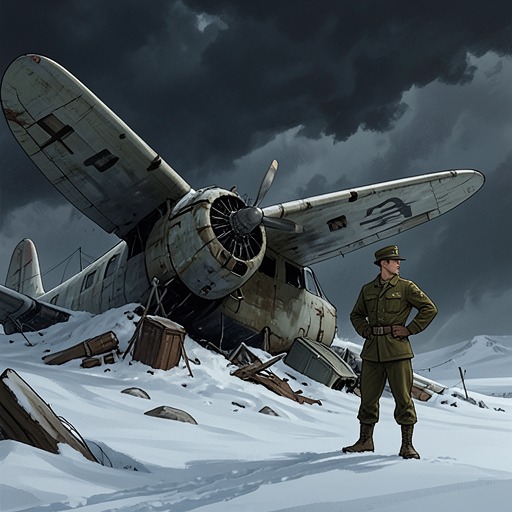
Colonel Miller led the expedition. His men established a camp in former British occupation barracks outside Höfn, then moved to a farm near the glacier and enlisted the brothers who lived there as guides. The brothers warned that, after days of snowfall, finding a crash site in the vast ice field would be unlikely. Their local knowledge led them to the rim of the plane’s nose wheel, about two kilometres onto the ice. The fragment was the expedition’s only find: beyond it, the snow-covered glacier gave no visible indication of a crash. Miller took charge of the wheel, but two severe storms ultimately forced him to abandon the search. The second storm buried tents and equipment beyond recovery.
Surveillance and a Renewed Search
The Army’s interest in the wreck persisted long after the first expedition. In 1967, a much larger search party was driven from the glacier by bad weather. In a later account of the surveillance effort, a former serviceman described regular flights over Iceland and the sea to its north, including monthly photographic runs over the south-eastern part of the glacier. The flights produced occasional suspicions that something had been sighted, but no confirmed discovery.
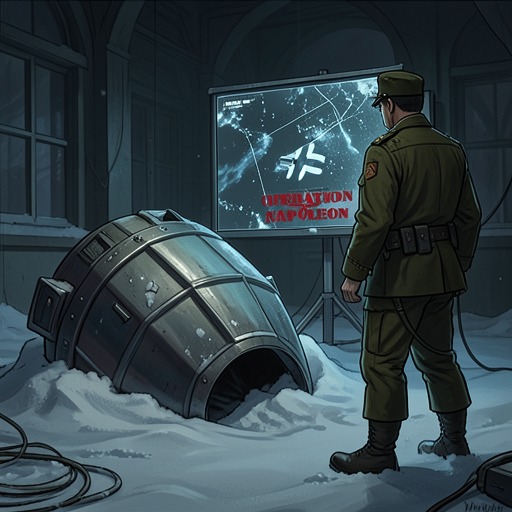
Decades later, new imagery appeared to show the glacier returning an object that the military had lost there. Vytautas Carr was ordered to direct the operation from Keflavík. He was to take two special-forces squadrons, select their equipment, present the work as a routine exercise, and refer uncooperative locals to the defence secretary. Carr was also told that the Icelandic government would receive an explanation and that Immanuel Wesson would speak for the American side from the embassy in Reykjavík. Carr understood the mission to be covert. His superior’s instructions made clear that concealment was part of the operation, not an incidental precaution.
The aircraft’s suspected contents sharpened that secrecy. When pressed about the cargo, Carr raised the story of the Walchensee gold: more than three hundred bags of gold bars sent out of the Reich shortly before the fall of Berlin. He then disclosed that most of the gold had been taken from concentration camps. The wreck was therefore not merely a military object to retrieve. Its cargo implicated the United States in the recovery of plundered Jewish property and made the historical record politically dangerous.
Command, Secrecy, and Icelandic Authority
The operation’s chain of command did not guarantee control over its agents. Carr worried that Ratoff, the mission director, was over-zealous, despite his record of delivering results. As Carr set phase two in motion, he decided to go to Iceland and first honoured an old promise by calling Colonel Miller to tell him the plane had turned up. Later, senior officials discussed the recovery plan: trucks would carry the dismantled aircraft and bodies to Keflavík, while Ratoff was instructed to turn over any papers he found. The possibility that he would read them was treated as an acceptable risk, even though the documents could expose the operation’s purpose.
The Army’s approach to Icelandic officials paired treaty-based monitoring claims with pressure to clear the glacier. At an emergency meeting, American representatives insisted that the discussion remain secret and invoked the defence treaty as authority for surveillance around Iceland’s borders. When Icelandic ministers raised a failed mayday response and demanded answers, an American general bluntly said that the rescue team had to leave. After the Icelandic prime minister threatened a formal protest, public investigations, and road closures, the general claimed that a German bomb lay on the glacier and that the team was endangered. Yet a pilot was later told that the German Second World War aircraft was safe and contained no bomb. The shifting explanations show how the language of security could be used to support both extraordinary secrecy and demands that Icelandic rescuers withdraw.
Ratoff eventually held the documents and sought an agreement with his superiors. He said that Carr had known what he was doing in putting him in charge. The exchange leaves the Army’s operation not as a single, smoothly executed command, but as a struggle among institutional secrecy, individual discretion, and the consequences of recovering evidence that could no longer be kept safely beneath the ice.